Care
How to keep a black dress black for years
Care for a black dress by its label: suitable washing, stain treatment, drying and storage, plus a quiz on fabric-specific decisions.
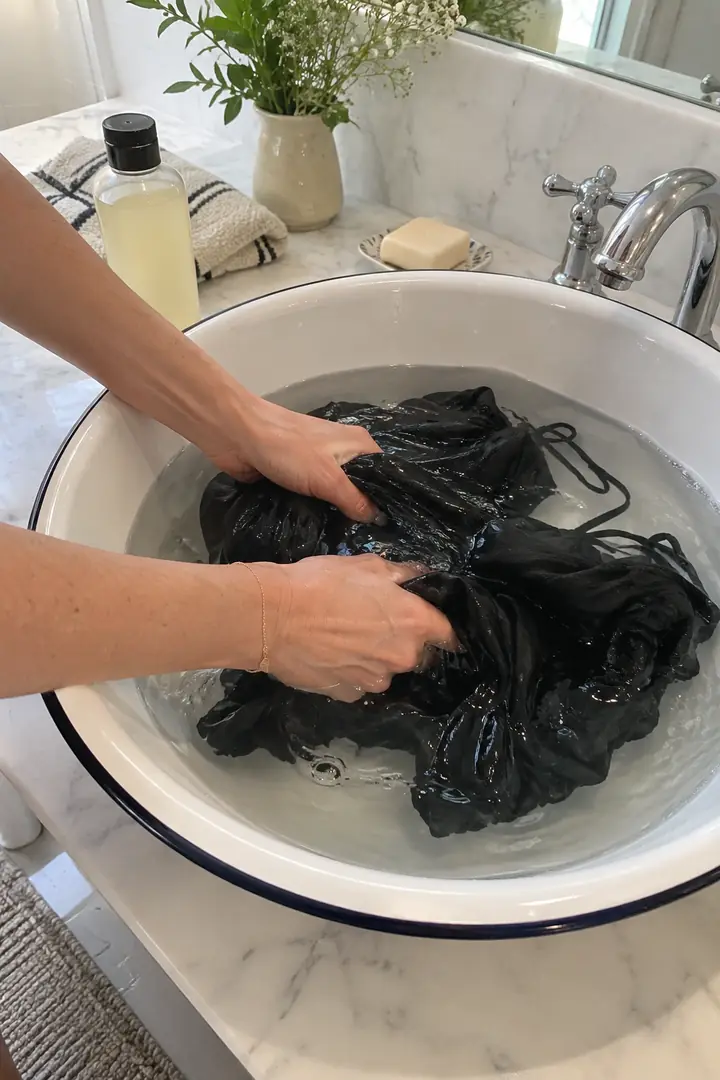
Start with the dress’s care label. When washing is permitted, suitable sorting, gentle handling and the stated drying method help preserve its colour and shape. Fabric, dye, finish and wear all affect the result; a black silk dress and a black cotton jersey dress need not share one routine. The five habits below are checks to adapt, rather than a guarantee against fading.
If you decide to sell a dress, compare the cash retained after fees, shipping and care rather than the listing price alone. The dress resale calculator: fees and net proceeds shows its method and lets you keep the calculation.
Why black fades
Black textiles do not all carry the same dye or a simple coating on the fibre surface. CottonWorks explains that dyes can diffuse into fibres and that some dye classes form strong bonds with them. Colour retention therefore depends on the fibre, dye and finish, as well as washing, abrasion and light exposure. A fading seam does not identify one cause by itself.
Care also affects shape. Excess heat or an unsuitable washing and drying process can distort some constructions. Use the label for the completed garment, including its lining and trims, rather than deciding from the name “ponte”, “silk” or “crepe” alone.
Habit 1: wash less, spot-clean more
Decide from soil, perspiration, odour and the garment’s care requirements, rather than a fixed number of wears. Air it between uses when suitable. Treat a small mark only with a method compatible with that fabric and finish; a damp cloth and soap are not appropriate for every dress.
Habit 2: choose the labelled wash process
If the dress is machine washable, turn it inside out where appropriate and follow the labelled temperature, cycle and detergent requirements. Sort it with compatible colours. A laundry bag may reduce rubbing but cannot make an unsuitable cycle safe. Follow the garment and product directions for additives instead of assuming that one routine suits every black fabric.
Habit 3: follow the drying symbol
Follow the drying symbol and any written instructions: flat drying, line drying and tumble drying are different processes. Support a wet knit if its label requires flat drying, and use a suitable hanger only when hanging is allowed. Do not assume that “low heat” makes every crepe or ponte dress suitable for a dryer, or that every silk dress can be washed and hung wet.
Habit 4: check whether ironing or steam is allowed
Check whether ironing and steam are allowed, then respect the labelled temperature. A pressing cloth may help protect an approved surface, but it does not permit heat or steam on a garment marked against them. Do not iron over embellishments without their specific instructions.
Habit 5: support the garment in storage
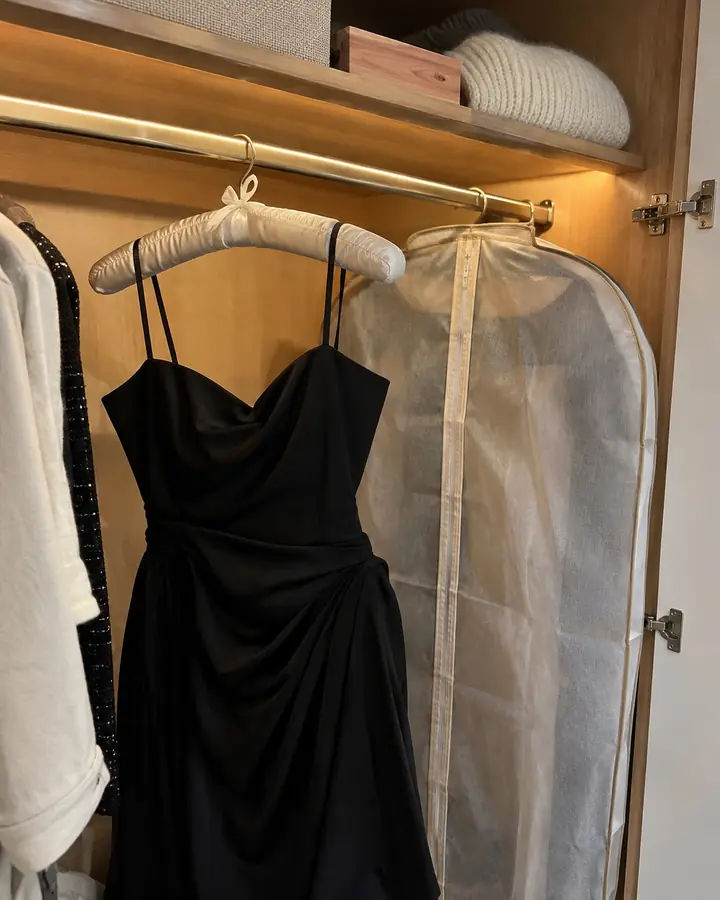
Store the dress clean and fully dry, away from strong light and excessive heat. Choose support for its construction: woven garments may suit a shaped hanger, while knitwear may need folding to avoid stretching. A cover does not replace suitable storage conditions or checks for pests. Avoid relying on a cedar block as a guarantee.
Care quiz
Choose true or false for each statement. The explanation appears after your choice.
1. A black dress should be washed after every wear to keep it looking fresh.
Not automatically. Decide from soil, perspiration and the care instructions. Airing or compatible spot treatment may reduce unnecessary full washes, but does not replace cleaning when the dress needs it.
2. Washing a black dress inside out reduces fading on the outside.
True. Turning it inside out reduces friction on the visible surface during the cycle.
3. Hot water is the best choice for removing stains from a black dress.
False. Choose a stain method and temperature allowed by both the garment and product instructions. A hidden test is useful, but does not override a do-not-wash label.
4. A tumble dryer on low heat is safe for ponte and crepe.
False as a blanket rule. A low setting is suitable only if the completed garment’s care label allows that drying process. Otherwise use the specified alternative.
5. Storing a black dress in a breathable garment bag helps protect it from dust and moisture.
True. Breathable covers keep dust off without trapping moisture the way plastic can.
Stains: act quickly, but gently
Identify the mark, remove excess gently and read the care label before adding water or a cleaner. For a washable item, use a compatible pretreatment and test discreetly. Do not mix products or keep repeating treatments that alter the colour or surface. Ask a professional about a valuable, non-washable or uncertain garment, and explain what caused the stain and what you already tried.
Pilling and bobbles
Pilling can occur where fibres rub together, and does not automatically mean the dress must be replaced. Use a method and tool suited to the construction, starting gently on a discreet area of dry, supported fabric. A purpose-made de-piller or gentle comb may be suitable; avoid improvising with an ordinary razor on a delicate knit. Stop if the fabric catches or weakens.
When to use a dry cleaner
Follow a dry-clean-only instruction. Structure, linings, dyes, finishes and embellishments can change the permitted care, so fibre content alone cannot settle the question. If the label is missing or unclear, ask the maker or a professional rather than assuming that silk, wool or beading always follows one rule.
Frequently asked questions
Does vinegar keep black dark?
There is no universal vinegar rinse that keeps every black dress dark. It does not replace faded dye, and an additive may be unsuitable for the garment or the washing machine. Check the relevant instructions before using one.
How often should I wash a black dress?
There is no fixed two-or-three-wear rule for every dress. Check soil, perspiration, odour and the care requirements; air or spot-treat between washes only where suitable.
Can I iron a black dress?
Only if its care label permits ironing, at the stated temperature and with any required precautions. Steam is not automatically safer for lace, satin or an embellished garment.
Further reading
What should stay visible when you prepare the dress for resale?
Prepare the actual garment according to its label, then record the condition that remains. Removing loose surface debris by a suitable method is different from removing a worn patch in an image editor. If a mark, repair or area of pilling remains, photograph it clearly and describe its location. A cleaning attempt is not proof that the issue has disappeared or that a future buyer can remove it.
| What you did | What still needs checking |
|---|---|
| Followed an allowed cleaning process | The resulting condition, fully dry and in ordinary light |
| Found a remaining mark | A clear detail and a wider location view |
| Changed a photo’s brightness | Whether the adjustment conceals actual wear |
The black-dress resale photography guide supplies a shot check that connects condition notes to visible evidence. Preserve your original files and avoid promising that an unknown stain will wash out. Choose a listing description that matches what you can presently observe.
Inspect a closure before choosing a care method
A care label and the condition of the fastening answer different questions. Before washing or sending a black dress for cleaning, look for loose lining, pulled tape or a zipper that separates. Tell the cleaner about an existing fault. Cleaning does not establish that a damaged fastening is repaired, and dark fabric can make a small loose edge easy to overlook.
| Area | What to note |
|---|---|
| Beside the slider | A visible caught lining or loose thread |
| Along the tape | A pulled seam or damaged surrounding cloth |
| After fastening | Separation or slipping already observed |
The side and back closure guide helps describe the opening without inferring quality from its position. Follow the dress's complete care instructions and obtain repair advice for a persistent fault. Do not add household lubricants or reshape hardware as part of a routine color-preservation step; those actions introduce separate material and repair questions.
Identify a rolling facing before repeating the pressing
A facing that repeatedly returns to the outside needs its construction checked as well as its care instructions. Note where it appears and whether the dress is off, worn or moving normally. This record gives a cleaner or repairer more information than a request simply to apply stronger heat.
| Question | What to show |
|---|---|
| Which pressing process is permitted? | The complete label, material and trim |
| Which piece is rolling? | The neckline from inside and outside |
| Is an attachment damaged? | The actual loose or broken stitches without pulling them |
The facing observation guide explains how understitching relates to the hidden layers. It does not establish that every neckline needs the same extra stitching. Keep any change after cleaning in the history without assuming its cause. Ask for an assessment before using glue, trimming an edge or altering the heat setting beyond the garment's instructions.
Have you compared a pile highlight before treating it?
Record a velvet area's appearance under consistent light before interpreting it as color loss. Directional pile can look lighter or darker from different positions. A persistent mark, a damaged surface and a shifting highlight are useful observations to keep separate when deciding what help to request.
| Observation | Next useful information |
|---|---|
| Appearance shifts with viewpoint | A pair of views of the same area under one light |
| A local mark remains | Its location, surrounding surface and care instructions |
| Finish or cleaning history is unclear | The maker's description and any known previous treatment |
Use the velvet appearance comparison to write that record without rubbing or pressing the surface first. Then follow the actual label or discuss the unresolved area with a suitable cleaner. The time you noticed a change can help explain the sequence, but it does not prove what caused it. A general explanation of pile is useful context; a treatment still has to suit the particular dress.