Care
Hemming a dress that has a slit, without closing the opening
Shortening a dress also shortens its slit. Measure the opening, then finish the hem and slit edges with a mitered corner. Includes a sample-first check.
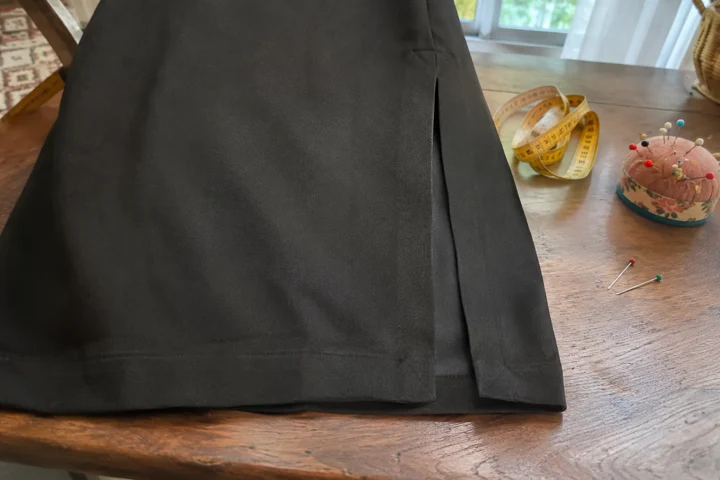
To hem a dress with a slit, finish the bottom edge and the slit edges as one continuous fold, joined by a mitered corner where they meet. Shortening the dress also shortens the slit by the same amount, because the top of the opening stays where it was stitched. Measure that before you cut anything.
What changes in a slit when you shorten the dress?
A slit is open from a fixed point at the top down to the hem. If you take 2 inches off the bottom, the opening loses 2 inches of its length while its top stays at the same height on your leg. A slit that was 6 inches long becomes 4. If you shorten by more than the slit's length, the opening disappears and the skirt closes up.
That is why a hem on a slit dress starts with a measurement, not with scissors. Put the dress on with the shoes you will wear, mark the new hem with pins, then measure from the top of the slit to that line. The result is the slit you will actually have. Compare it with the figure you want for walking and sitting before you commit.
| What you measure | What it tells you | What to do if it is wrong |
|---|---|---|
| Slit top to the old hem | The current opening length | Write it down before pinning anything |
| Slit top to the new pinned hem | The opening you will have after hemming | If it is too short, shorten less or reopen the seam above the slit |
| Step length, with the dress pinned | Whether you can walk without the skirt pulling | Take a longer stride in the mirror and adjust the opening, not the hem alone |
How do you hem the slit and the bottom edge together?
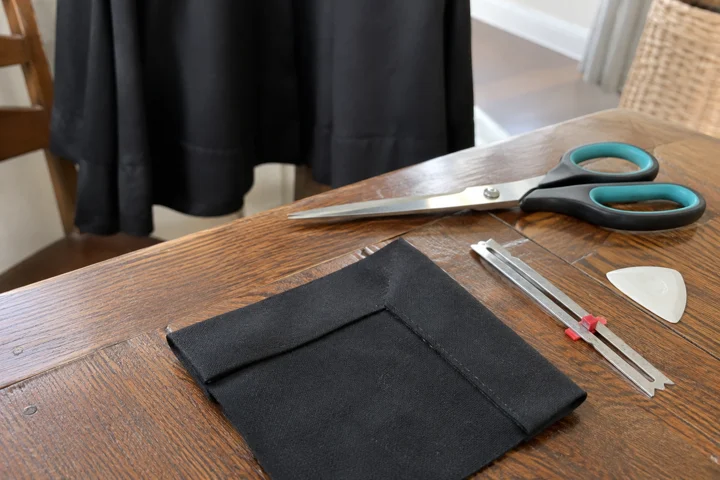
The method most tutorials share is a mitered corner. It lets the side-of-slit fold and the bottom fold meet on a 45-degree line instead of stacking as two thick layers. Two public sewing guides show it step by step: We All Sew's mitered corner hem presses a 5/8 inch fold and then a 1 inch fold on both edges, and Vikisews' mitered corner describes the version used on vents and slits, with the seam trimmed to about 1/4 inch and the corner clipped to reduce bulk.
- Finish any raw edges first. On a fabric that frays, overlock or zigzag the cut edge.
- Press the slit edge and the bottom edge by the same amount, so the two folds are equal in width.
- Fold the corner on the diagonal where the two creases cross, then press the diagonal.
- Stitch along the diagonal, trim the corner, and turn it out to a point.
- Stitch the hem and the slit edge in one pass, pivoting at the corner.
This is a method to rehearse, not a guarantee for every cloth. Fine, slippery or thick fabrics behave differently, so use the sample step below.
Why practice the corner on a paper square first?
A mitered corner is easiest to understand with something you can fold and throw away. Cut a square of scrap paper, fold in two edges by the same width, and fold the corner on the diagonal. Seeing where the folds land shows why the two widths must match: if they differ, the point sits off-line and the opening pulls open or twists.
When the paper works, repeat it on an offcut of the dress fabric, or on the inside of a seam allowance, before touching the finished hem. Look at the corner from the front, then sit and stand in the sample dress and see whether it lies flat. Our black dress fabric guide explains why a crepe, a satin and a velvet need different handling.
What should you check before and after you stitch?
Check the lining first. If the dress has one, the lining and the shell may need separate hems, and the lining should stay shorter than the shell. The guide to a lining that shows below the hem shows how to compare the two edges. Check also the care label before pressing, because heat that is safe for one fiber can mark another.
After stitching, put the dress on and take a normal step, then a long one. The opening should show what you intended, the corner should lie flat and no thread should pull. If the hem hangs unevenly, unpick only that stretch rather than the whole hem. A black hem hides stitches well, but it also hides mistakes until daylight, so check it by a window. For the overall proportions of the finished length, read the black dress length guide.
When should you take it to a tailor instead?
Consider a tailor when the slit sits in a bias-cut skirt, when the fabric is silk or velvet, when the dress is lined and the lining has its own slit, or when you need to shorten by a large amount. A tailor can also move the top of the slit, which a home hem cannot do. Ask what the alteration will do to the slit length before you book it, and bring the shoes you will wear. This guide is a sewing method, not a measurement of your dress; the numbers above come from the tutorials cited, and your fabric may need other allowances. The little black dress guide covers fit checks that help you decide how much length to change in the first place.
Questions about hemming a dress with a slit
Does hemming shorten the slit?
Yes. The top of the opening stays fixed, so every inch removed from the bottom is removed from the slit.
What is a mitered corner hem?
A finish where the bottom fold and the slit fold meet on a diagonal, which keeps the corner flat and reduces bulk.
Can you hem a slit dress without a sewing machine?
You can hand-stitch it, but the corner and the folds still need to be pressed to equal widths first.
How much hem allowance should a slit have?
Public tutorials use about 5/8 to 1 inch folds. Check the allowance your dress actually has before cutting anything.