Care
Dress lining showing below the hem: check before cutting
Check the layers, outer hem and movement before shortening a black dress lining. Know what to show at a fitting and why one fixed distance will not suit all.

If a dress lining shows below the hem, first check that the dress is sitting correctly and that the outer hem has not come undone. Compare the layers standing and after walking. A lining alteration may help, but cutting immediately can hide a twisted layer, damaged attachment or changed outer hem.
Is it the lining or a separate slip?
Take the dress off and look inside in good light. A lining belongs to the dress and connects to it at construction points. A slip is a separate garment you can remove. An intentionally visible contrast layer is another possibility: compare the maker's photographs before treating every lower edge as a fault.
The Sewing & Craft Alliance lining guide distinguishes a separately assembled lining from underlining worked with the outer pieces. That distinction matters because an attached layer cannot always be shortened like an independent underskirt. Our slip guide covers the separate garment instead.
Check the dress before changing the length
Put the dress on with the undergarments and shoes you intend to wear. Settle the shoulders and waist without pulling either skirt down. Look at the front, back and sides in a full-length mirror. Record where the lining appears: all around, only one side, at a slit, or only after moving.
Walk a few steps, sit and stand again. A layer that catches temporarily needs a different assessment from one that hangs below the shell while both layers are relaxed. Do not pin a hem while wearing it alone; a fitting helper or alterations professional can mark the layers without distorting your posture.
| What you see | Next check |
|---|---|
| Even exposure around the hem | Compare both finished lengths and the shell hem |
| One low section | Look for twisting, an uneven hem or a loose attachment |
| Exposure only at a slit | Check the slit construction with the dress at rest and moving |
| Problem appears after sitting | Observe how the layers return before deciding to shorten |
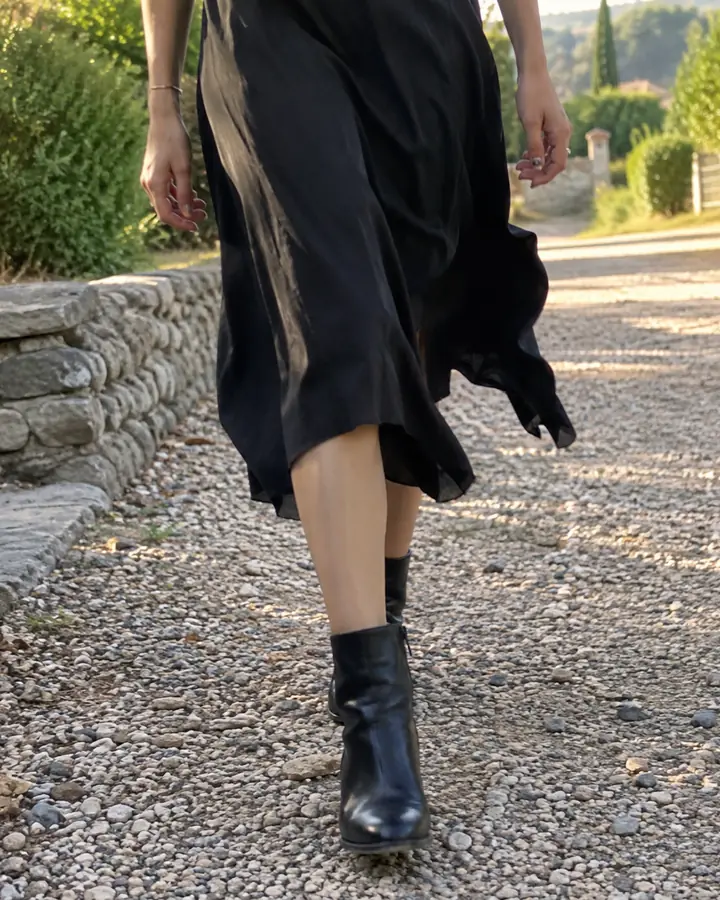
Check the outer hem and connections
Look for an outer hem fold that has dropped, stitching that has opened, or fabric caught at the waist or zipper. Compare the dress's present shape with an earlier photograph if you have one. A recent cleaning or alteration is useful history, but timing alone does not establish the cause.
Small loose connections between lining and shell may be intentional movement allowances. Do not cut them just because they look like spare thread. Equally, a broken connection merits inspection rather than simply tucking the loose layer upward. Check fabric and construction separately: a satin-looking lining does not identify its fiber or safe pressing temperature.
What should an alterations professional change?
Bring the whole dress, not just a measurement of the exposed strip. Ask which layer is causing the mismatch, whether the lining has sufficient room to move, and how the finished edge will behave at the vent or slit. Agree the result with the garment on before fabric is removed.
A fixed rule such as removing an inch from every lining misses differences in shape and construction. A flared edge also has a different circumference from a point farther up the skirt. The finished fold must lie smoothly; a wide turn-up can create fullness rather than solve it. For overall proportions, use the dress-length guide before approving changes to the shell itself.
Choose your next step
I have not checked the inside yet
Identify the layer and inspect the shell hem before buying tape or cutting fabric.
The same strip shows while standing and walking
Book a fitting with both layers visible and ask for a finished-length assessment.
The layers shift differently after sitting
Show that movement at the fitting. Describe the sequence rather than requesting only a shorter lining.
What if the event is today?
Try the dress on early enough to choose another outfit if the layers will not sit comfortably. Folding a large amount upward, adding adhesive to an unknown finish or fastening the lining tightly to the shell may change the hang. A visible lining is less important than being able to walk and sit without a makeshift fastening pulling on delicate fabric.
Lining questions
Should a lining always be invisible?
A concealed lining normally stays inside the shell, but intentional layered designs differ. Check the intended design first.
Can I cut the loose edge?
Establish the correct finished length and edge treatment first. Cutting leaves no allowance for a later correction.
Does a longer lining prove the dress shrank?
No. Inspect the garment and its history; several construction or fit changes can alter the relationship between layers.