Care
What to check when a dress armhole feels too small
Dress arm holes too small? Separate a shallow armhole from a short bodice or lining strain with a simple four-line fit record before any alteration.
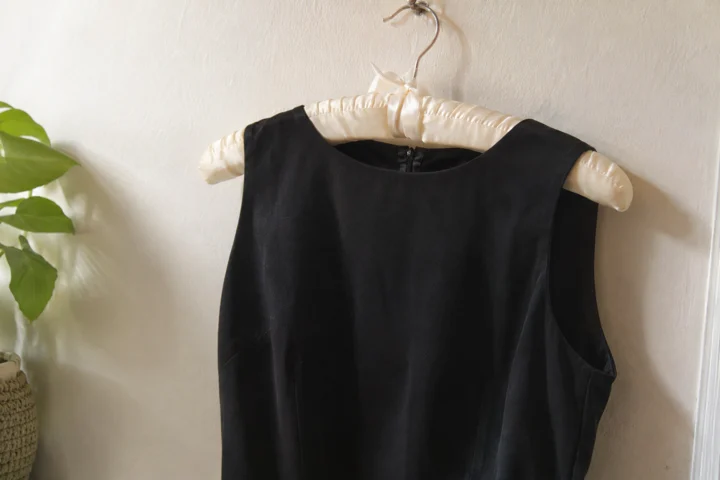
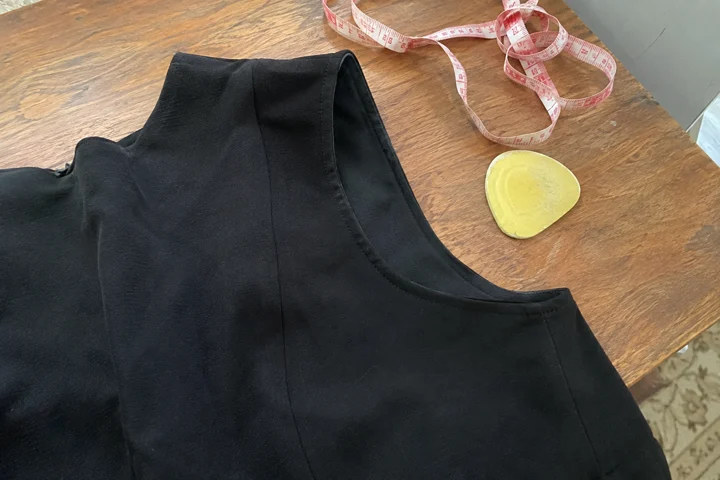
If the arm holes on a dress feel too small, do not cut the armhole first. Check whether the edge digs into the arm, the bodice pulls up from the waist, or the seam sits too far toward the front. Only an edge that is pinching on its own is a local alteration; the other two are fit problems.
Where does the armhole actually pinch?
Put the dress on over the underlayers you plan to wear and raise your arms slowly. Note the spot where the edge presses: the front of the underarm, the bottom of the curve or along the shoulder. Stop at pain. Pulling harder only stretches seams. A little black dress that fits well should let you reach forward without the whole bodice travelling upward.
Then lower your arms and check the side seam. If it has moved toward the front, or the waist seam rises, the bodice is the issue. Threads magazine makes the same point in its guide: fit the bodice first to get the right armhole, because the armhole depends on the shape of everything around it.
Is it the armhole or the bodice length?
A bodice that is slightly short between shoulder and bust drags the armhole edge upward into the underarm. Compare the dress laid flat with one that fits you. If the bust point sits higher than yours, more armhole depth will not cure it. Measure from the shoulder seam to the fullest part of your bust and compare it with the garment; a tailor can say whether length can be added at the waist seam.
NMSU Extension publishes a pattern alteration guide that treats bodice length and armhole changes as separate adjustments. We cite it for that distinction only; a finished dress rarely has spare fabric to behave like a flat pattern.
| What you notice | Likely source | What to ask a tailor |
|---|---|---|
| Edge presses only at the bottom of the curve | Armhole too shallow | Can the curve be lowered a little if seam allowance exists? |
| Bodice rises when you reach | Bodice too short or too narrow across the back | Can the waist seam or back be released? |
| Fabric pulls from front to back | Insufficient width across the upper arm or shoulder | Is a gusset or side-seam release possible? |
| Only tight in a lined area | Lining narrower than the shell | Can the lining armhole be trimmed or recut? |
What should you check before any cutting?
Turn the garment inside out. Find the seam allowance at the armhole and at the side seam, and note whether the armhole is finished with a facing, binding or lining. A narrow allowance leaves little room to release; cutting into the finished edge cannot be undone. Compare the shell and lining: a woven lining does not stretch the way a knit shell may, so a dress can feel tight even though the visible fabric has give.
Avoid snipping the curve to relieve the pull. Clips relax the edge for a moment but can fray or leave the armhole gaping. Do not wash the dress hot to loosen it either; shrinking from a repeated wash will not enlarge a seam.
A four-line fit record before you ask for alteration
Write down four things: where the edge presses; what happens when you raise one arm; whether the bodice rides up at the waist; and what the armhole is finished with. Add a photograph from the side with your arm lowered and one with it lifted. This record is a proposed method, not a test we ran on your garment. It lets a seamstress judge whether the change is a small armhole adjustment or a larger bodice alteration, and it avoids paying for the wrong repair.
When is it better to choose another dress?
If the dress needs changes at several seams, or the armhole is tight and the fabric has almost no allowance, compare the cost of alteration with replacing it. For an event, plan the fitting well ahead and wear the intended underlayers at every fitting. Keep the first outfit that is comfortable with your arms raised.